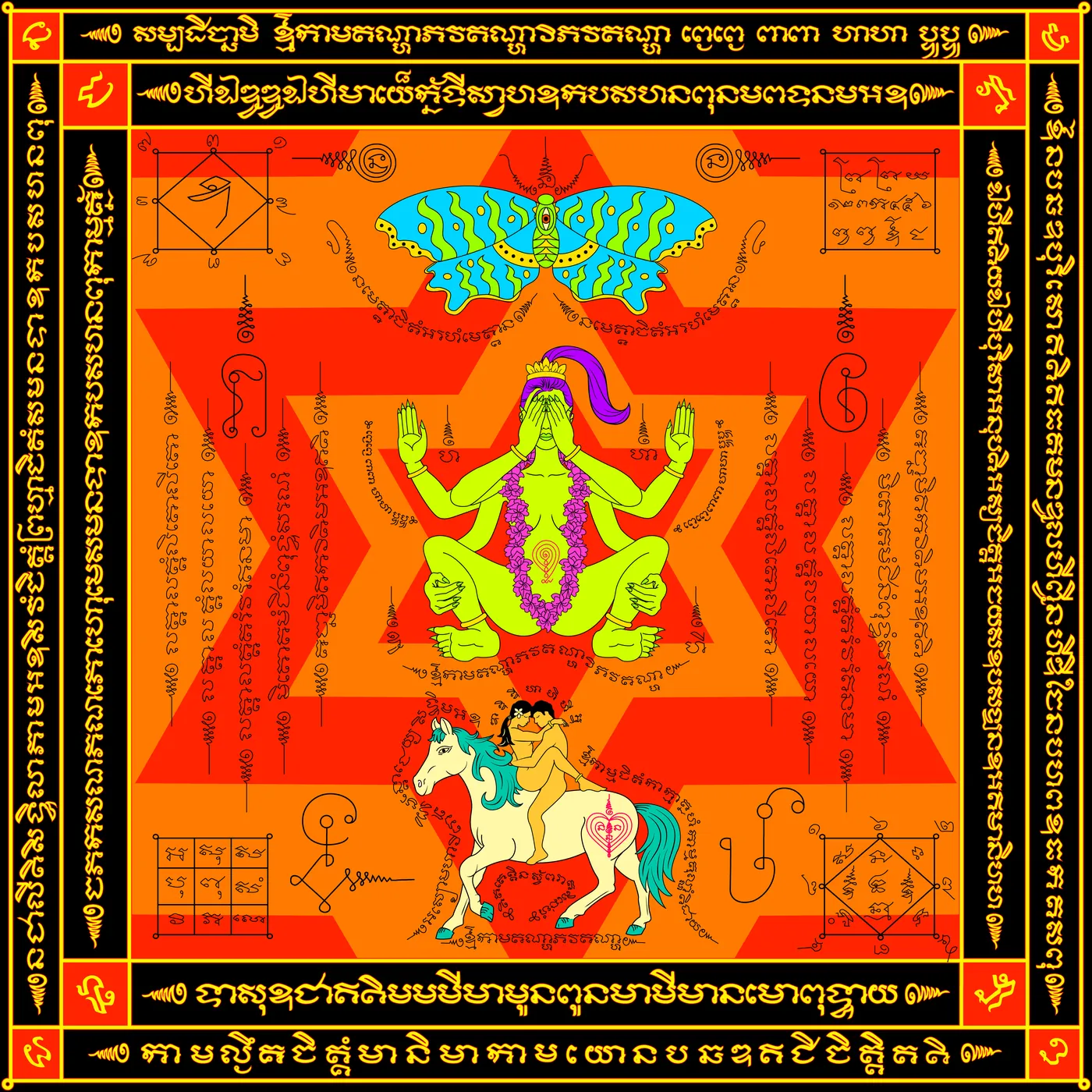
A Working Cloth, Not a Picture
The first generative pha yant series, to my knowledge. The first in full colour devoted to Phra Ngang. The first printed to glow under UV.
Why I Made This
Generative art — building thousands of unique pieces out of a set of hand-made parts — was the one genuinely new way to make images to come along in years. Then the NFT frenzy got hold of it and ran it straight into the ground: ten-thousand-piece sets of smirking apes and cartoon birds, scarcity invented for its own sake, flipped and forgotten, the whole thing running on irony. I found it repulsive — a real tool, wasted on garbage.
So I pointed the same method at something that mattered to me. It took four years. I lettered every line of Khom by hand, copied every sigil out of a working ajarn's grimoire, and redrew every figure until it could live in a generative layout and still be right. It was closer to an obsession than a project.
The Form, and a New Way to Make It
A pha yant is a Thai ritual cloth — a working diagram, traditionally empowered by a monk or ajarn, meant to put its bearer in a deity's field rather than just depict him. The form has strict rules: a central figure, set yantra geometry, Khom script, Sanskrit border invocations, and flanking guardians and sigils drawn from a fixed pool. None of it is there to look nice. Each element does a job, in a set place. These follow that grammar as an artist's devotional work, designed and verified with a Thai ajarn — not a consecrated temple amulet.
Everything was drawn by hand. No AI image generation, no model output, nothing prompt-derived anywhere in it. A Bangkok sak yant artist drew the figures, postures, hands, and guardian animals; then I adjusted and coloured them in Illustrator.
Normally a pha yant exists one of two ways. A temple screen-prints an edition of identical cloths — hundreds or thousands of the same design, blessed in a batch. Or an ajarn hand-paints a single one-off. Identical editions at one end, singular pieces at the other, and nothing in the middle. Generative composition fills that middle: 1,999 flags built from a hand-drawn vocabulary, no two the same, each still obeying the rules of the form. To my knowledge it's the first time a pha yant series has been made this way.
And it suits the tradition better than it suits almost anything else. A sacred image here isn't a picture of the deity — it's treated as a presence of him. So these aren't 1,999 versions of one image. They're 1,999 of him, each appearing once and retired the moment it's claimed.
Making the Darkness Conscious
Most Westerners picture Buddhism as a kind of psychology — self-help with the mysticism filed off. In Southeast Asia it's nothing of the sort: centuries of mysticism, magic, scripture and sorcery, tangled up with Hindu devas, ghosts and astrology. The version most people grew up with is a small, sanded-down corner of it, and spirits like Phra Ngang live in the rest.
This collection draws on saiyasart — the “midnight science,” the darker end of Thai folk magic the temple keeps at arm's length. Every diagram was worked through with Ajarn Maha Mettaboon, pulling scripts and sigils straight from his own grimoires. When I first brought him the finished work he told me the sacred lettering was wrong — the sak yant, the Khom, the Sanskrit, all of it — so we tore that layer down and rebuilt it from scratch, sigil by sigil, for each series: wealth, attraction, invulnerability, reversal of black magic, fast luck. It was a working collaboration, not a consultation.
And then there's Phra Ngang. He isn't a black-magic spirit, though that's where most people file him. Instead he's something a little stranger — the “holy fool,” tied to black magic because he's made of the things Buddhism is trying to transcend: lust, risk, hunger, the drive to win. Working with Phra Ngang doesn't mean you have to indulge in your vices (although many do); instead it's about facing your own darkness directly instead of pretending you're above it.
Phra Ngang himself is seldom given the form at all — he is not a temple-merchandise spirit. The pieces that surface are mostly single, hand-drawn cloths on deliberately transgressive ground: a burial shroud, a section of brothel sheet. Sex and death, the two poles of his domain.
Full colour is its own departure. The pha yant is an affordable, popular form, and most are screen-printed in a single ink — gold or red on dark cloth. Full-colour pieces are already unusual; full-colour pieces of him, rarer still. In a decade in this world I've seen maybe two pha yants of Phra Ngang at all, and both were black and white.
There's a logic to keeping him in the dark. He's a worldly spirit — radically immanent, dedicated to appetite and excess, to everything the tradition usually handles with restraint. Rendering him in the full spectrum, in colour that lights up, runs against the grain of how he's always been treated. That's what makes a full-colour series devoted to him a first, to my knowledge: not only that it hasn't been printed, but that the form has never looked at him quite this directly.
Night Vision for Dark Times
Pha yants are traditionally painted or printed in pigments that read in ordinary light. This collection is rendered in UV-reactive ink on 30 × 30 cloth tapestries — made to live in two registers.
In daylight, the flag reads as a complete devotional diagram: figures, postures, sigils, sacred script, the full visual grammar of the tradition. Under blacklight, the same flag opens. Edges glow. The Khom reads as floating script. The figures take on a presence they didn't have in daylight. The room changes around the work.
No one has printed a pha yant in UV-reactive ink before, to my knowledge. This tradition has always absorbed new visual technology as it arrived — new scripts, deities, lineages, printing methods — and blacklight is the next one.
And it's not an arbitrary medium for this figure. Phra Ngang is nocturnal and liminal — a spirit of thresholds, worked at night. A medium that lies dormant in daylight and reveals itself only in the dark belongs to him completely. A pha yant is meant to be a working object, not a picture, and rendering this one on a band of light the eye can't catch in daylight is a way of saying exactly what it is: a thing tuned to a different frequency, dark until it's lit. Each flag is made, in the tradition's own terms, to widen Phra Ngang's foothold here — a material portal for a nocturnal spirit.
Per-Piece Interpretation
Every piece comes with its own written interpretation — what the posture means, what the flanking guardians bring, what the sigils emphasize, and how the diagram is read in the tradition.
See What You Get for the full description of what arrives with each piece, and Working for how the interpretation is used in practice.
The Record
Each flag's fingerprint, and the collection as a whole, is sealed into a permanent public record the moment it's made. The record proves — to you, a future owner, or anyone curious — that the piece existed exactly as described, on the date it was made. It can't be backdated, altered, or quietly reissued.
The entire Codex — all 1,999 flags — was sealed to a permanent, independently verifiable timestamp on October 31, 2026. Anyone can verify it.
The record is anchored using OpenTimestamps, an open public timestamping standard. No account, blockchain wallet, or token is involved on your end — the flag is a physical object, and the record is simply a way to prove when it was made.
Merit
You don't play with a spirit like this without giving first. That's how the tradition works, and it's older than anything new about this project. A share of every sale goes to the Childline Thailand Foundation, which feeds, shelters, and protects children living on the streets of Bangkok.